Disclaimer: These are personal observations from someone who grew up in India and is still figuring out how the world works. Take it all with a pinch of salt.
Note: I wrote down my raw thoughts and observations during the trip. This blog was formatted and organized with the help of AI.
Spain was my second country. Before this, I’d spent three weeks in Japan. Both trips have done something to me. Made me realize how much of my worldview was shaped just by growing up in one place. India is all I knew for a long time, and traveling has a way of quietly rearranging your assumptions.
I visited Madrid, Barcelona, and Valencia. If I had to rank them: Madrid > Barcelona > Valencia (though Valencia is a small city, so it’s not entirely a fair comparison).
Here’s what I noticed.
The Everyday Life
The first thing that struck me was how calm everything was. Spain is quiet in a way India simply isn’t. No horns, no chaos, no constant background noise. Walking through Madrid felt almost surreal. The streets were clean, the pace was slow, and nobody seemed to be in a hurry to get anywhere.
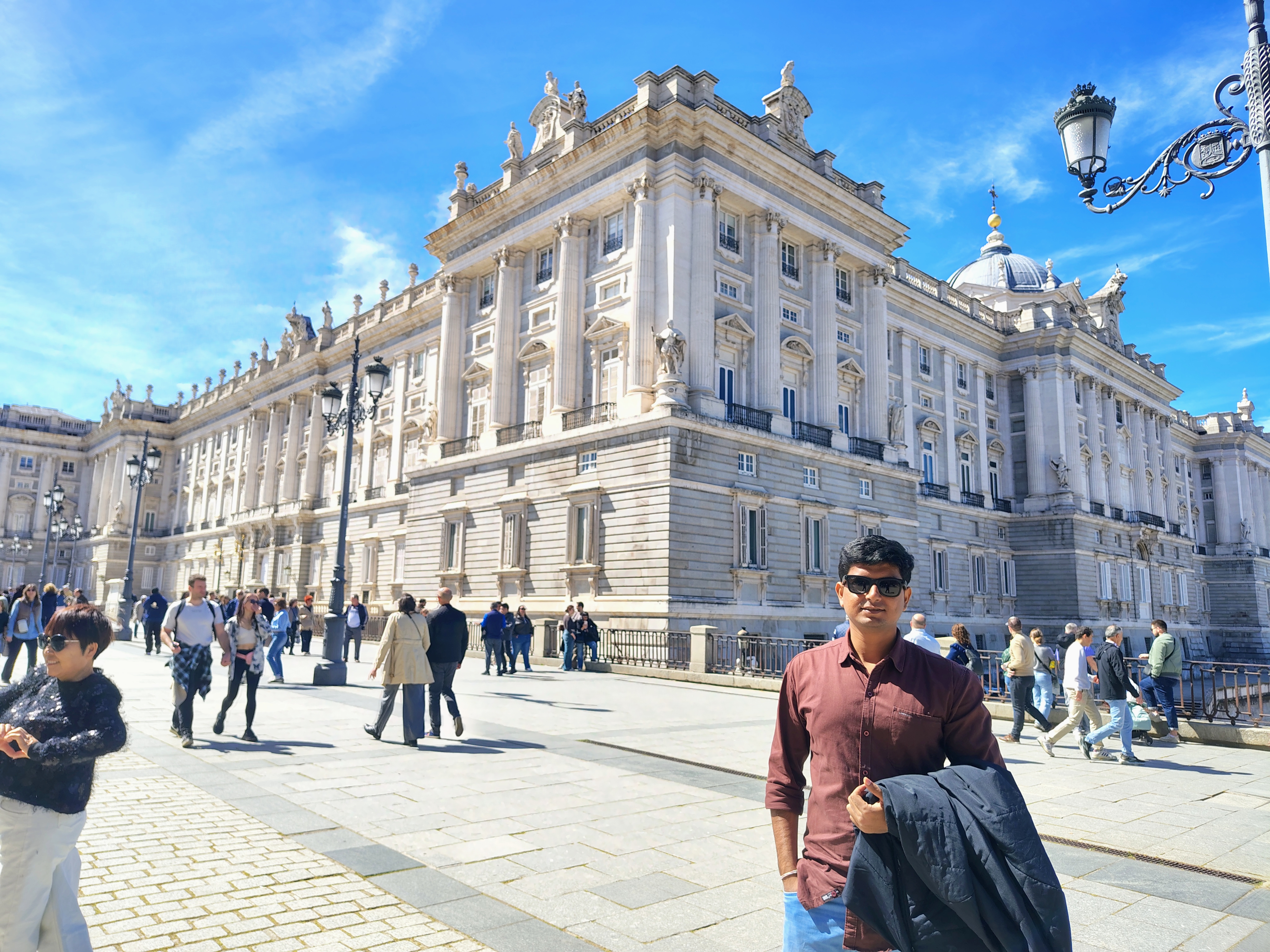
The city aesthetics were genuinely beautiful. Unlike Japanese cities, which tend to be functional and efficient but not particularly artistic, Spanish architecture has a soul to it. The buildings feel designed, not just constructed.
Public transport was reliable and well-organized. I used trains, local buses, and state buses. Everything ran on time. Garbage bins on every corner (harder to find in Japan, interestingly). No speed bumps on the roads. Buses had toilets. Small things, but they add up to a quality of life that you feel without being able to fully explain.
One thing I found genuinely interesting: buses had no conductors. You just get on, tap your card, and go. It’s a small sign of a high-trust society. There was also Bizum, a peer-to-peer payment system similar to India’s UPI. It worked well everywhere. Credit cards too. I never once struggled with payments.
People and Society
Spanish people are warm. Noticeably so. In Japan, people are polite but reserved. You can feel a quiet distance. In Spain, strangers talked to me first. Multiple times, people assumed I spoke Spanish and just launched into conversation. I found myself fumbling through with: hola, gracias, por favor, adios, si, no, no español, hablo inglés. Somehow, it worked.
Women in Spain have a visible freedom that I noticed as an Indian. They drive buses and trains. They move through public spaces without the kind of constant awareness that women in India often have to carry. Couples show affection openly. None of this is dramatic. It’s just normal there. And noticing it made me think about how much “normal” depends on where you grew up.
I also noticed a lot of families. Babies in prams, young children everywhere. That felt different from Japan, which had a noticeably older demographic feel.
There was a lot of immigration, especially from South America. The shared language makes Spain a natural destination. I found people generally open and welcoming toward immigrants, including me. I faced no discrimination anywhere.
The Feeling of Being an Outsider
This one is harder to write about, but I want to try.
I didn’t experience racism. Not even close. But there was a feeling, something I still can’t fully name, that came from walking through crowds of mostly white people, knowing I looked different. Nothing was said or done. It wasn’t hostility. It was more like a quiet awareness of my own visibility.
And then, one day, I spotted someone who looked like they were from my part of the world. And I felt something relax in me. That surprised me.
It made me think about groupism, about how human beings are wired to feel ease around familiarity. I’m not calling it a good thing or a bad thing. I’m just saying it happened, and it was honest. It made me understand, in a small way, why immigrant communities cluster together. Not always by choice, but because being around people who share your context is genuinely comforting.
Language and Identity
Most people in Spain only speak Spanish. Outside of hotels and tourist spots. Google Translate was my constant companion, and honestly, I didn’t mind. There’s something fun about trying to piece together a language on the go.
What I didn’t expect was the Catalan-Spanish language tension. Once I read into the history, it made sense. Language is identity, and people fight for it. It made me think about India’s own language politics: Hindi vs. Tamil, Marathi vs. outsiders, and so on. My personal take: if you’re moving somewhere for a few years for work, you don’t need to learn the local language. But if you’re settling down and making it your home, learning the language is a form of respect. It helps you integrate instead of just coexisting in parallel.
Religion, Culture, and Holy Week
I happened to be there during Holy Week, which I didn’t plan but was glad to experience.
The processions were slow and ceremonial. Very different from the noise and color of Indian festivals. I won’t pretend I found it exciting; I didn’t. But I could see that it meant something real to the people participating. It just wasn’t made for tourists.
Most young Spanish people I talked to identified as Catholic but said they don’t follow it strictly. More “spiritual than religious.” The older generation seemed more devout. What I found interesting is that Spain lets you officially identify as non-religious or atheist. In India, being without a religion isn’t really a formal category. It’s assumed you belong to something.
Someone asked me about Hinduism during the trip, and I was caught off guard. I couldn’t explain it clearly. That was a strange moment: to be asked about something I’ve lived inside my whole life and realize I’d never had to articulate it from the outside.
Food, Weather, and the Good Stuff
The weather was genuinely wonderful. Sunny, warm, but not humid. You could walk for hours and not break a sweat. After Mumbai, this felt like a gift.
Spanish food is good. I enjoyed it the first week. By the second week, I was eating Indian, Mexican, and Turkish. I don’t think that’s a knock on Spanish food. I think that’s just what happens when you eat the same cuisine every day.
The bread was excellent though. Really excellent. I liked the empanadas in particular.
One slightly mortifying moment: I was meeting a woman I’d known online for the first time in person. She just leaned forward slightly, expecting me to know what to do. In Spain, you greet with air kisses on both cheeks. I knew this in theory. In practice, I froze. Apparently everyone else is just born knowing this.
I did notice quite a few beggars at tourist spots, something I hadn’t seen in Japan at all. And older people generally seemed fit and independent, doing things themselves rather than relying on others. That was nice to see.
The Economy
Spain felt, to me, like a country in maintenance mode. Not declining, but not aggressively building either. What was built is well-maintained. Quality of life is high. But there’s a sense, especially among young people, that opportunities are limited. Finding a job is genuinely hard. It came up in conversations more than once.
I noticed EV adoption was still low. Lots of petrol cars on the road. A small thing, but it pointed to something about the pace of change.
If I had a remote job paying in US dollars or pounds, I’d genuinely consider living in Spain. The quality of life is real. The cost of living is manageable by international standards. But I wouldn’t move there to depend on the local economy.
Regrets and Small Observations
My biggest regret: I paid €160 for a day trip to Toledo and Segovia. I later found the same trip for €90. Do your research before booking anything.
Rooms have no fans, just air conditioning. That took some getting used to.
No jet sprays in bathrooms. I missed them. Japanese toilets feel like a distant dream.
Indians, as a group, are loud in public. I noticed this more traveling abroad than I ever did at home.
Sunglasses are not optional. Pack them.
No stray animals anywhere. No dogs, no cats, no crows circling overhead, no pigeons underfoot. Coming from India, where they’re just part of the background.
Spanish people are shorter than I expected compared to other Europeans. Next to Dutch or German or British people, the difference is noticeable.
I was surprised by how many people had heard of Mumbai. I expected blank looks. I got conversations instead.
South Asian tourists were rare. I could spot the occasional group from a distance.
At some point, I realized I could roughly identify where people were from just by hearing them speak. A few words and I’d think: French, German, Italian. I’m not sure when I developed that ear.
Coming Back
Two weeks isn’t enough to understand a country. I know that. These are surface-level observations from someone passing through. But travel has a way of showing you things about yourself that staying home doesn’t.
Spain made me think about trust, language, identity, belonging, and what quality of life actually means. It also made me appreciate things about India I’d stopped noticing: the festivals, the energy, the chaos that somehow works.
I’ll do Japan next. I should have written it down sooner, but better late than never.